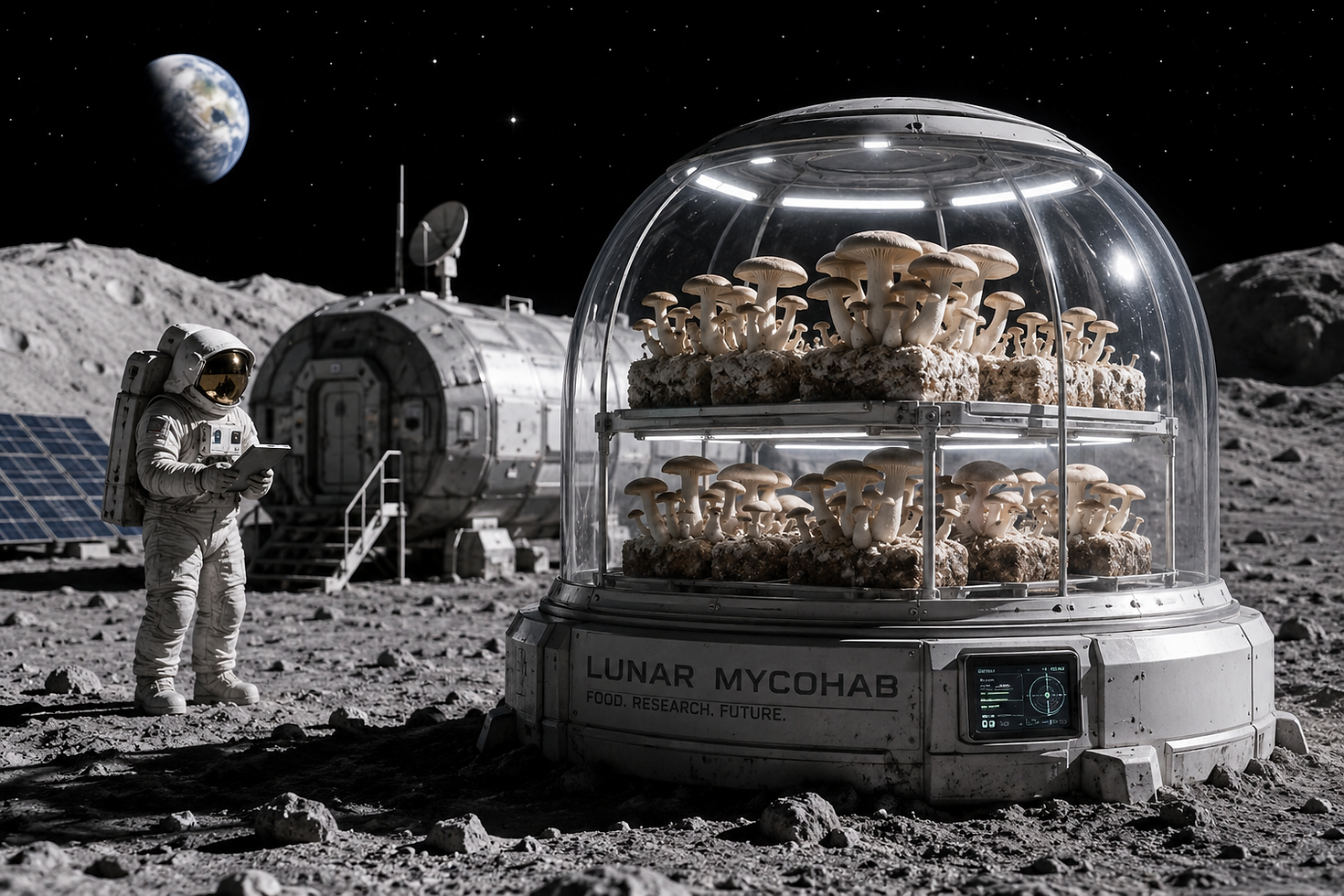
Could algae and fungi create a sustainable home on the moon? A Brown University team has pitched the concept.

On the heels of Artemis II’s mission to the moon, officials at NASA are focused on their goal of building a permanent moon base. And global teams of scientists and engineers are already working on realistic designs to colonize outer space.
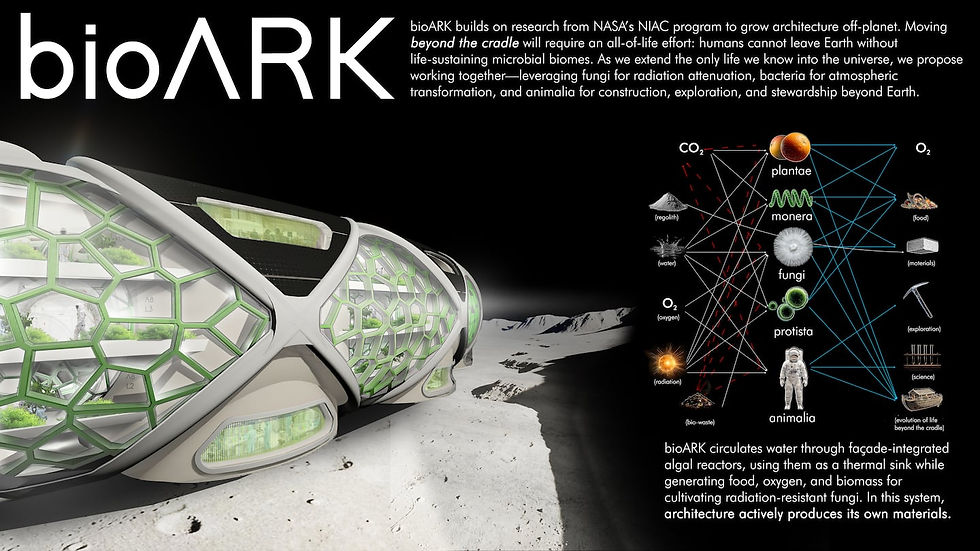
One off-planet idea is called bioARK, a self-sustaining space habitat made with algae, created by a team at Brown University, NASA scientists, and architects. Their proposal received honorable mention from the Aurelia Institute Prize in Design for Space Urbanism, a contest that evaluates concepts for near-future space stations, lunar habitats, and autonomous industrial facilities.
The contest sought entries that are physically possible, and benefit Earth and efficiency in space. The panel, which included Artemis II astronaut Victor Glover, who recently made a historic trip around the moon, picked the winning project and four honorable mentions from six finalists.
“Moving beyond the cradle will require an all-of-life effort: humans cannot leave Earth without life-sustaining microbial biomes,” according to the submission by Lynn Rothschild, a NASA Ames Research Center scientist, James Head III, a Brown University research professor, and Christopher Maurer, an architect at redhouse studio architecture.
The bioARK design pumps water through algae-filled panels built into the walls of the habitat. Those panels regulate thermal energy to help control temperature, while the algae grown inside them produce food, oxygen, and raw materials. The architecture actively produces its own materials.
The fungi can withstand radiation, sheltering the inhabitants.
Rothschild, who pioneered the use of synthetic biology for space exploration and is an adjunct professor at Brown, talked to the Globe about her out-of-this-world project.
Q. How did a viral student-based project lead to the idea for bioARK?
Rothschild: Around 2013, I challenged my students to make a biodegradable drone — and I was not focused much on the body of it because I knew we weren’t going to be judged heavily — but I did have a student who had learned a little bit about building with fungi, something that we now call Myco-tecture. Mycology is a study of fungi — tecture is from architecture — sort of like architecture with fungi.
What the student did is he got this company in upstate New York who’s really been a pioneer in the field — Ecovative — to build the body of our drone. And then at the end of it, New Scientist wrote a big article on our project, and the project went viral. So for about 13 months, if you would search for NASA and drone, you would have come up with our little fungal drone. I became very aware of it, and it started me thinking, ‘Gee, I wonder if could build something more with it off planet,’ and came up with a habitat.
How are you preparing your concept for implementation?
[We’re] testing some of these technologies on the surface of the moon. I’ve convinced NASA headquarters this is important. We almost had a flight on Intuitive Machines’s (IM-3) mission that ended up not going. NASA asked for a new budget, which I should have to headquarters in the next few days. They’re telling us to be hardware ready in 12 to 15 months. ... I’m not going to rest easy until we have one of these little cities growing on the surface of the moon, preferably Mars, so I can say to everyone, “Yes, it’s doable. Here it is.”
Why choose algae and fungi as a component of this?
I got into biology because I looked through a microscope when I was 8 and fell in love with algae and protozoa. But basically, if you look at Planet Earth, algae and now plants have really been that interface between the raw materials on the planet, like carbon dioxide and the atmosphere. The minerals and water and the organic matter that feeds the rest of the living biosphere. You’ve got plants photosynthesizing, and then we eat plants, and something else eats us. That’s the easy way, that’s the elegant way that we’ve been making organic matter on Planet Earth for over 4 billion years. That’s the algal component.
Why does fungi make a good construction component?
Filamentous fungi are great. Fungi in general are big stomachs. They will literally eat garbage. But with filamentous ones, as opposed to something like yeast, which is a single cell, these filamentous will just keep growing until they run out of food. ... It will bind things. You don’t need to worry about glues. You don’t have to worry about the off-gassing of other chemicals that might be hazardous to breathe. The fungi will grow to fill whatever shape you have, unlike dealing with wood or steel beams. You can go around corners. You can have it grow in any conformation you want. The flammability is really low. Turns out it’s got really great acoustical [and insulation] properties.
Why is bioARK’s approach considered important for long-term space travel?
What became apparent is that we’re the only ones who actually have had funding and been thinking about this for a long period of time. We have been challenged to be more realistic through this project for 10 years. The others have not.
How far away do you think we are from bioARK as a possibility?
It’s physically possible. I can’t speak to how soon NASA, or any other country or private entity, is going to have a real colony on the surface of the moon. Hopefully, sooner rather than later.
What I do want in the next two to three years is to have a little model, one of these growing on the surface of the moon, and that’ll say, in principle, this works, and I’ll just scale it up. I do have some control over what I can get to the surface, and I want to grow little houses in the next couple of years.

